Archaeological news about the Archaeology of Later Medieval Europe from the Archaeology in Europe web site

Tuesday, 19 February 2019

Helle's toilet: 12th-century three-person loo seat goes on display

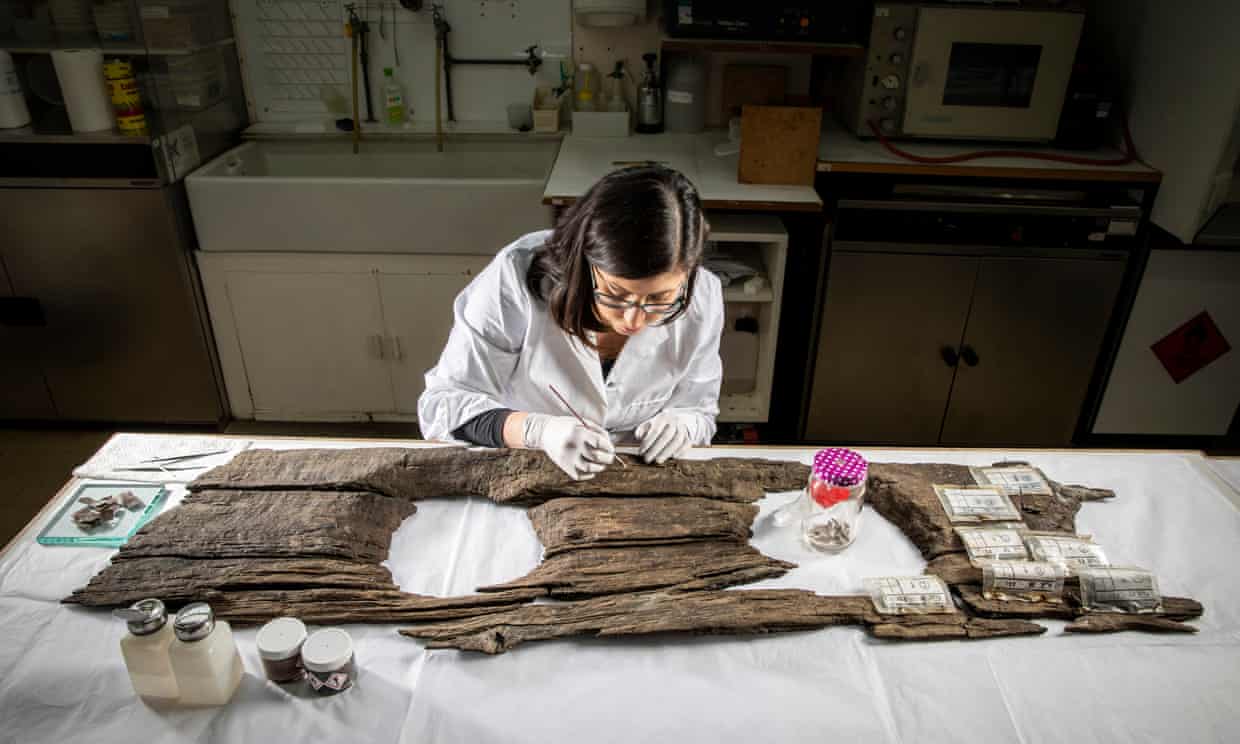
Conservator Luisa Duarte working on the 12th-century toilet seat. 
Photograph: David Levene/The Guardian

Archaeologists know the names of the owners of the building where plank of oak sat
A rare 12th-century toilet seat built to accommodate three users at once is to go on display for the first time at the Museum of London Docklands.

Nine hundred years after the roughly carved plank of oak was first placed over a cesspit near a tributary of the Thames, it will form the centrepiece of an exhibition about the capital’s “secret” rivers.

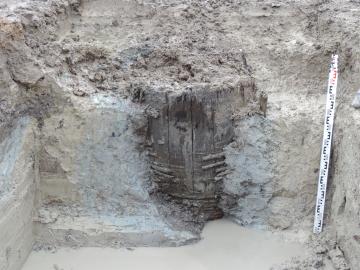
The strikingly well preserved seat, still showing the axe marks where its three rough holes were cut, once sat behind a mixed commercial and residential tenement building on what is now Ludgate Hill, near St Paul’s Cathedral, on land that in the mid-1100s would have been a small island in the river Fleet.

Read the rest of this article...

Monday, 18 February 2019

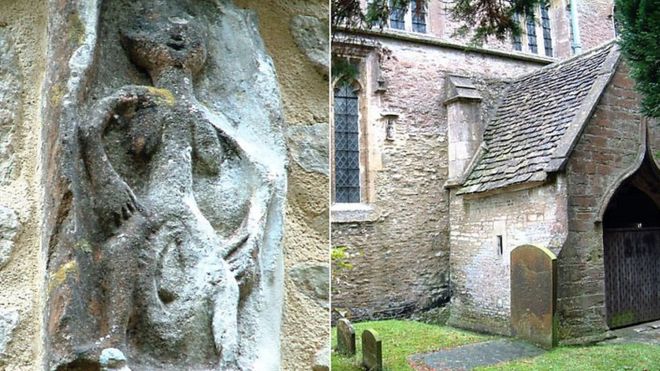
Sheela-na-gigs: The naked women adorning Britain's churches

This sheela-na-gig at Oaksey in Wiltshire boasts "pendulous breasts" and a vulva
"extended almost to her ankles"
For hundreds of years carvings of naked women have sat provocatively on churches across Britain. But who created them - and why?
Look at these, my child-bearing hips
Look at these, my ruby red ruby lips...
Sheela-na-gig, Sheela-na-gig
You exhibitionist
The year is 1992 and the singer-songwriter PJ Harvey is performing Sheela-Na-Gig, the most successful single from her critically acclaimed album Dry.
But unless you're a fan of late 20th Century indie music, or an expert in Norman church architecture, there's every chance you've not been exposed to the sheela-na-gig - or have sauntered past one without even realising it.
Hidden in plain sight, these sculptures of squatting women pulling back the lips of their vaginas have for nearly a millennium aroused feelings of intrigue, shame and even anger.

Read the rest of this article...

DES FORTIFICATIONS ET UN HABITAT DU MOYEN ÂGE À HARFLEUR


À Harfleur (Normandie), les équipes de l’Inrap ont mis au jour des éléments de fortification remarquables, dont une tour creuse et un ouvrage défensif avancé (casemate), ainsi que des vestiges d’habitation des XIIIe et XIVe siècles. Ces découvertes viennent enrichir l’histoire de ce port stratégique de l’estuaire de la Seine, supplanté seulement au début du XVIe siècle par le Havre.

Read the rest of this article...

Friday, 27 July 2018


Archaeologists were hoping to find the first hermitage built in Cacela Velha, in Algarve, after the Christian conquest, but the remains that were unearthed in the area belonged instead to a medieval Christian necropolis and to an earlier Islamic settlement.

Cristina Garcia, from the Regional Direction of Culture (DRC) of Algarve, explains that the work is a continuation of the excavations undertaken in 1998 and 2001, in which the remains of what was thought to be the hermitage were detected, but it soon became apparent that the existing walls were, in fact, part of an Islamic bath abandoned by the Arabs before the Christian conquest and that they were later covered by a medieval Christian necropolis.

"Because the walls appeared to lie above the Christian necropolis, it was thought that they belonged to the hermitage, but only more burials of the medieval Christian cemetery were found, which had been used until the 15th or 16th century, and now we need to determine what the precise boundaries of this cemetery are", says Cristina Garcia.

Read the rest of this article...

Thursday, 19 July 2018

Old Theban port of Chalcis: A medieval maritime crossroads in Greece

Medieval ceramic article from Chalcis typical of main Middle Byzantine Production (MBP), 
in the collection of the Musée National de Céramique and the Manufacture de Sèvres 
(Cité de la Céramique) [Credit: S. Y. Waksman]

Showcased in museums the world over, Byzantine ceramics are the vestiges of an ancient empire that dominated the Mediterranean region for nearly ten centuries. One CNRS researcher, in cooperation with Greek colleagues, has focused her attention on a widely disseminated style of ceramics called the “main Middle Byzantine Production,” found in all four corners of the Mediterranean. Its origins had remained a mystery until these scientists traced it back to Chalcis (Khalkís), the former port of Thebes. They determined that the town had been a maritime hub from which goods were shipped to Marseille, Acre (in modern-day Israel), and beyond—as far as Chersonesus in Crimea. The team's findings have just been published online by the Journal of Archaeological Science: Reports.

In the 12th century, the Byzantine Empire was flourishing and the city of Thebes--between Corinth and Athens--was a bustling center of commercial and cultural exchange. Its outlet to the sea was the port of Chalcis, part of a vast maritime trade network. In addition to agricultural products and silk, ceramic tableware was shipped from Chalcis throughout the Mediterranean. Most of this tableware has been assigned to the main Middle Byzantine Production (MBP) ceramic type.

Read the rest of this article...

New DNA sample could prove whether Richard III was guilty of murdering the 'Princes in the Tower'


New scientific research could finally solve one of Britain’s most controversial historical mysteries.

Geneticists have succeeded in obtaining a sample of DNA that could ultimately prove whether the medieval English King Richard III was guilty or innocent of murdering the two children of his predecessor, Edward IV – the so-called Princes in the Tower.

The discovery of the crucial modern DNA is revealed in a new book, The Mythology of the ‘Princes in the Tower’, published this week.

Richard III – whose skeleton was discovered in Leicester just six years ago and whose identity was confirmed through DNA testing, was portrayed as a villain by Shakespeare and the Tudors.

Read the rest of this article...

Polish archaeologists discover medieval graves in Sicily


Polish archaeologists discovered over 800 years old burials during excavations near the medieval church of San Michele del Golfo near Palermo in Sicily. According to the scientists, the graves could belong to the Normans, descendants of the Vikings.

"Some of the dead buried in the cemetery were undoubtedly members of the elites or the clergy, as the form of some of the graves indicates" - says head of excavations Prof. Sławomir Moździoch from the Institute of Archaeology and Ethnology of the Polish Academy of Sciences in Wroclaw.

This year, archaeologists found a total of 10 burials, including three graves of women and two graves of children. The remaining skeletons were difficult to identify. According to the discoverers, the cemetery was associated with the church hospital mentioned in a document from the 12th century. Unfortunately, no equipment was found in any of the graves.

Read the rest of this article...