Archaeological news about the Archaeology of Later Medieval Europe from the Archaeology in Europe web site

Thursday, 28 April 2016

‘Lost’ songs from Middle Ages brought back to life


An ancient song repertory will be heard for the first time in 1,000 years this week after being ‘reconstructed’ by a Cambridge researcher and a world-class performer of medieval music. 


Detail from the Cambridge Songs manuscript leaf that was stolen from and then recovered by Cambridge University Library [Credit: Cambridge University] 

‘Songs of Consolation’, to be performed at Pembroke College Chapel, Cambridge on April 23, is reconstructed from neumes (symbols representing musical notation in the Middle Ages) and draws heavily on an 11th century manuscript leaf that was stolen from Cambridge and presumed lost for 142 years. 

Saturday’s performance features music set to the poetic portions of Roman philosopher Boethius’ magnum opus The Consolation of Philosophy. One of the most widely-read and important works of the Middle Ages, it was written during Boethius’ sixth century imprisonment, before his execution for treason. Such was its importance, it was translated by many major figures, including King Alfred the Great, Chaucer and Elizabeth I.

Read the rest of this article...

Tuesday, 26 April 2016

11 reasons William Shakespeare was the original Shoreditch hipster


An archaeological dig is expected to find Shoreditch is the home of Shakespeare, putting Stratford-Upon-Avon and the Globe in the shade.
The Museum of London Archaeology is leading a project to uncover and explore the remains of the Curtain Theatre, the 16th and 17th century venue where Shakespeare is known to have first staged Romeo and Juliet.Heather Knight, the senior archaeologist leading the dig on behalf of MOLA, said: “People often go to Stratford-upon-Avon to take in Shakespeare’s birthplace and his grave.
Read the rest of this article...

Friday, 22 April 2016

Archaeologists discover skeletons of cows and pony, domestic oven and industrial complex in medieval Scottish town


From wells to a pony, a huge dig next to the 19th century Town House in the Scottish town of Irvine has produced some amazing archaeological finds dating back to the 13th century. Claire Williamson, who is leading the project for Rathmell Archaeology, takes a look around the site


"This is a view of the Irvine Town House site before the archaeological work begins, but after the demolition of the structures that used to stand here.

This ground, destined for development, lies in the core of the medieval burgh of Irvine. As such, it offered an unrivalled opportunity for archaeologists to explore the origins of the town and the people who lived, worked and built our community over the centuries."

Read the rest of this article...

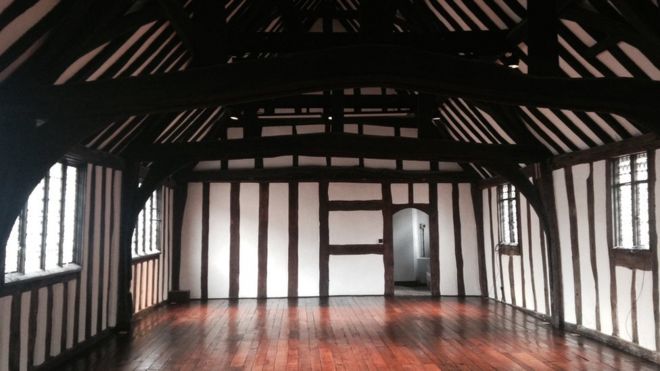
Shakespeare's 'original classroom' revealed


The young Shakespeare would have had his school lessons and seen his first plays in this room 

The original classroom where William Shakespeare is believed to have studied and seen his first plays opens to the public for the first time this weekend.

The classroom is owned by the King Edward VI school, the direct successor to the grammar  school in Stratford-upon-Avon attended by Shakespeare from about 1571.

It will be open to visitors after a £1.8m lottery-funded renovation.

Among the discoveries was a hidden pre-Reformation wall painting.

Read the rest of this article...

Tuesday, 12 April 2016

ARCHAEOLOGISTS DISCOVER 10TH CENTURY CHURCH, COINS TESTIFYING ABOUT 1242 TATAR (MONGOL) INVASION OF MEDIEVAL DRASTAR IN BULGARIA’S SILISTRA

A 10th century church with a necropolis has been discovered by the Ruse archaeologists during their participation in the rescue digs in the nearby Danube city of Silistra, the modern-day heir to Durostorum (in the Antiquity) and Drastar (in the Middle Ages). 
Photo: Ruse Regional Museum of History

church from the 10th century, dozens of medieval graves, and coins testifying to the Tatar (Mongol) invasion of theSecond Bulgarian Empire (1185-1396 AD) in 1242 AD have been discovered during rescue excavations of the medieval city of Drastar, known as Durostorum in the Antiquity, in today’s Danube city of Silistra in Northeast Bulgaria.
These findings have just been presented to the public by archaeologists Nikola Rusev and Varbin Varbanov from theRuse Regional Museum of History; the discoveries were made in the late summer and fall of 2015 when their team participated in the rescue excavations in the city of Silistra after a local water supply rehabilitation project exposed a number of archaeological structures from different time periods.
The rescue digs in Silistra, which was a major regional center in the Antiquity and Middle Ages, continued for several months as part of the rehabilitation of the city’s water supply and sewerage system. They also led to the discovery of the outer fortress wall of the Ancient Roman city of Durostorum (as the city was known in the Antiquity period).
Read the rest of this article...

Monday, 11 April 2016

Rare chess piece found in back yard of museum


THE smallest medieval Arabic chess piece to be discovered in the country has been unearthed in an archaeological dig at Wallingford Museum. 

At first curators at the museum in High Street thought the artefact was a tiny carving of a cat. 

But a closer examination revealed it was a chess piece made from the tip of an antler, and further pieces could be found when a second dig is carried out at the visitor attraction in July. 

Curator Judy Dewey said: "We have joked that we will pick up the other 31 pieces and the board but of course that's very unlikely."

Read the rest of this article...
 The Aedicule at the heart of the Church of the Holy Sepulchre is in need of repairs 
Credit: GALI TIBBONGALI TIBBON/AFP/Getty Images

The Church of the Holy Sepulchre, the Jerusalem holy site where Jesus is thought have been crucified, is as often the scene of Christian rivalry as brotherly love. 

Catholic, Armenian and Greek Orthodox priests jostle for space under its great dome, sing during each other's prayers and occasionally engage in sectarian fist fights

But the three communities have set aside their differences for a task all can agree is of critical importance: restoring the crumbling structure of Jesus's tomb. 

At the heart of the church is the Aedicule, a towering shrine built on what is said to be the spot where Jesus was buried before rising from the dead three days later.

Read the rest of this article...